01
Inspect the bottle
Identify flexible panels, neck rings, shoulders, handles and decorative surfaces that may limit contact.
Bottle control
The capper can only apply a consistent closure when the bottle remains aligned and resists rotation. Neck support, body clamping, guides or side belts are selected around the actual container and capping method.
Direct answer
A bottle that spins, leans or collapses under the capping load can produce high, loose, marked or cross-threaded caps. The support method may act on the body, shoulder, neck or side walls depending on bottle shape, rigidity, filled weight and the available clearance around the closure.
More clamping force is not always the answer. Excessive pressure can deform lightweight bottles or alter the neck position. The correct approach is proved with filled production samples and the actual cap, tooling and conveyor conditions.
Decision evidence
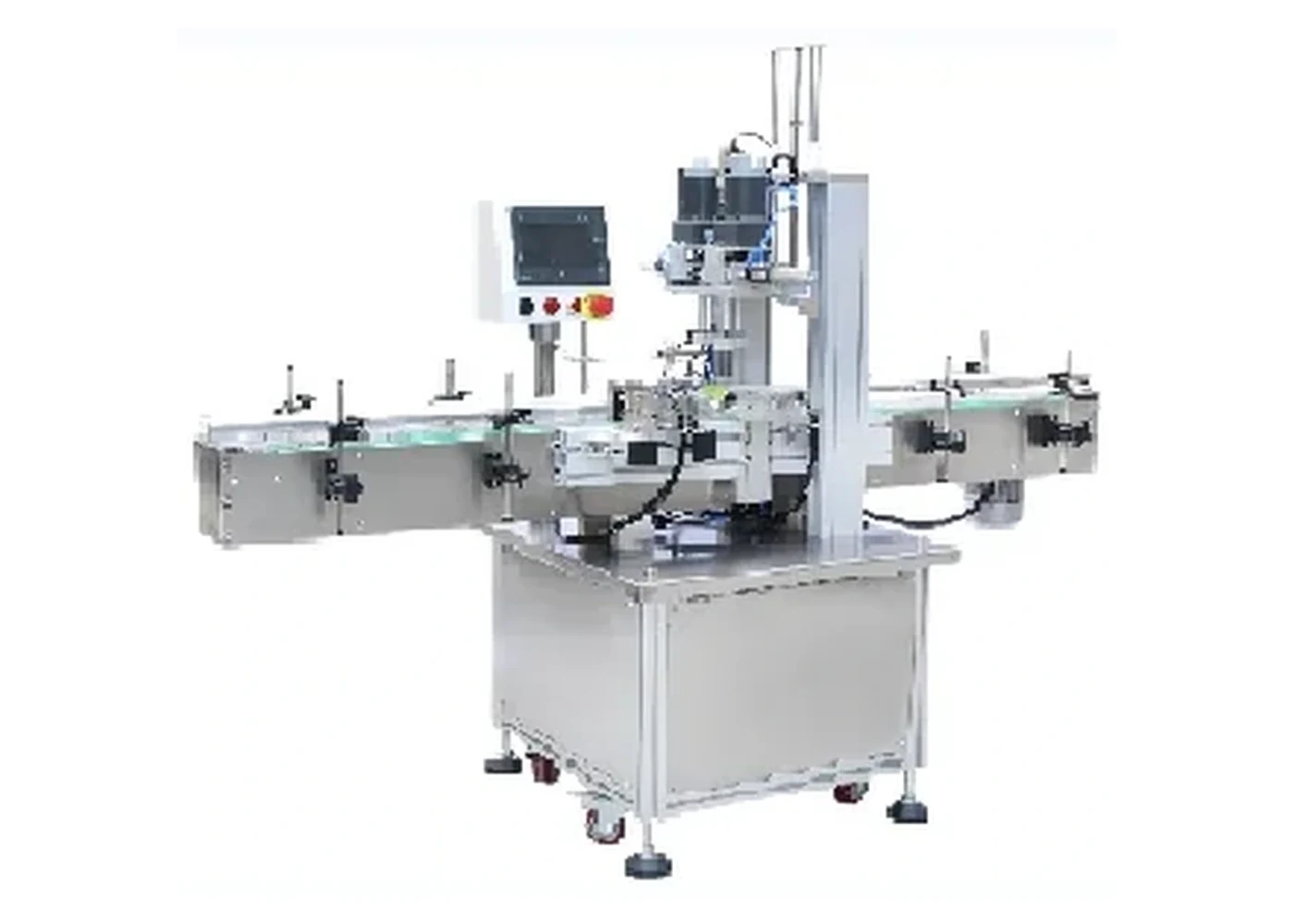
The same bottle may need different support on a bench capper, indexed single-head machine or continuous spindle line.
| Observed risk | Support question | Trial evidence |
|---|---|---|
| Bottle spins during tightening | Can the body, neck or shoulder be restrained without scuffing or deformation? | Mark the bottle position and observe rotation throughout the complete cycle. |
| Bottle leans under the head | Are guides, base support and vertical alignment sufficient at the capping point? | Check cap level around the circumference and repeat with production fill weight. |
| Lightweight wall collapses | Is force being applied to a flexible panel rather than a stronger neck or shoulder feature? | Inspect before and after capping and reduce unsupported body loading. |
| Tall bottle becomes unstable | Does the centre of gravity require higher side support or controlled acceleration? | Run starts, stops and normal conveyor transfer, not only a static cap cycle. |
| Square or oval bottle rotates | Can a shaped guide, clamp or indexed pocket control orientation? | Test each orientation and format extreme under the intended cycle. |
| Spindle capper loses contact | Are side-belt pressure, height and speed holding the bottle consistently? | Observe pre-tightening, successive spindle contact and outfeed release during a timed run. |
Practical method
A stable pack makes torque and cap-position evidence more meaningful.
Identify flexible panels, neck rings, shoulders, handles and decorative surfaces that may limit contact.
Fill or ballast representative bottles so centre of gravity and wall response match the intended process.
Set the bottle support so the neck and closure remain centred under the head or through the spindle path.
Use enough control to prevent rotation and movement without crushing, marking or slowing transfer unnecessarily.
Include normal line interruptions, restart spacing and outfeed so support remains reliable outside steady running.
Keep guide, clamp, neck-support or side-belt settings with the approved cap-height and closure checks.
Buyer questions
Bottle support is a format-specific part of the capping setup, not a universal fixed pressure.
Neck support is useful when the bottle body is too flexible, unstable or unsuitable for reliable anti-rotation, or when the capping load must be controlled close to the neck finish. The available support ring, shoulder geometry and closure clearance must be checked on the real pack.
Sometimes, particularly on continuous inline spindle systems, but the decision depends on bottle rigidity, shape, contact area and required capping force. Side belts must stabilise the bottle without squeezing or marking it, and their speed and pressure must be proved with production samples.
Lightweight bottles can distort when clamping or side-belt pressure acts on flexible walls, when the neck is not supported or when the capping load is transferred through an unstable body. Filled weight, temperature and bottle design can change the response, so trial conditions must represent production.
Square or oval bottles may need shaped guides, indexed orientation, pockets or controlled body contact so the bottle cannot turn as torque is applied. Test all relevant orientations and confirm that labels, mould seams, shoulders and handles do not interfere with the support method.
Check bottle alignment, freedom from damage, cap level, thread engagement, torque or opening evidence and transfer into and out of the station. Run enough packs to include normal starts, stops and component variation before the new setting is approved.
Continue the decision
Use the most relevant next page to prepare the pack, trial or machine specification.
Control flexible containers without crushing, spinning or losing thread alignment.
Use seated position to confirm that bottle movement has not affected closure engagement.
Compare semi-automatic, automatic single-head and spindle routes for bottle formats.
Lancing can review neck support, body restraint, guides and side-belt handling with the actual bottle and closure family.